
TL;DR:
- Digital tools are transforming parental involvement by enhancing communication, engagement, and learning support. Effective platforms like TalkingPoints and learning dashboards foster meaningful two-way interactions, improving outcomes and attendance. Balancing technology with active, shared parent-child activities is essential to maintain relational quality and participation.
The role of technology in parental involvement is the use of digital tools and platforms to actively engage parents in their children’s education, improving communication, support, and learning outcomes. Platforms like TalkingPoints, Seesaw, and Worldreader Kids represent a new generation of purpose-built tools that connect families to schools in ways that were impossible a decade ago. Research from 2026 shows that 81% of parents have used AI for parenting tasks, with many doing so daily. That figure signals a fundamental shift in how families approach learning support at home. Technology in education is no longer a school-only concern. It belongs to parents too.
How does technology support communication between parents and schools?
Digital communication tools are the most direct expression of the role of technology in parental involvement. When a parent receives a timely, personalised message in their own language, the barrier between home and school shrinks considerably. The impact is measurable: TalkingPoints improved student grades by 2.5 to 4.9 percentage points and raised attendance by 1.1 percentage points in a large urban district. That is not a marginal gain. It demonstrates that reducing communication friction directly translates into better outcomes for children.

The design of these platforms matters enormously. Reducing communication friction and delivering messages in families’ primary languages substantially improves engagement. Generic parent portals that push out one-way newsletters rarely achieve this. What works is two-way dialogue, contextually relevant updates, and accessibility for non-English-speaking families.
Effective digital tools for parental engagement include:
- Messaging platforms such as TalkingPoints, which offer multilingual translation and two-way communication between teachers and families
- Video call tools including Microsoft Teams and Zoom, which enable virtual parents’ evenings and one-to-one consultations without travel barriers
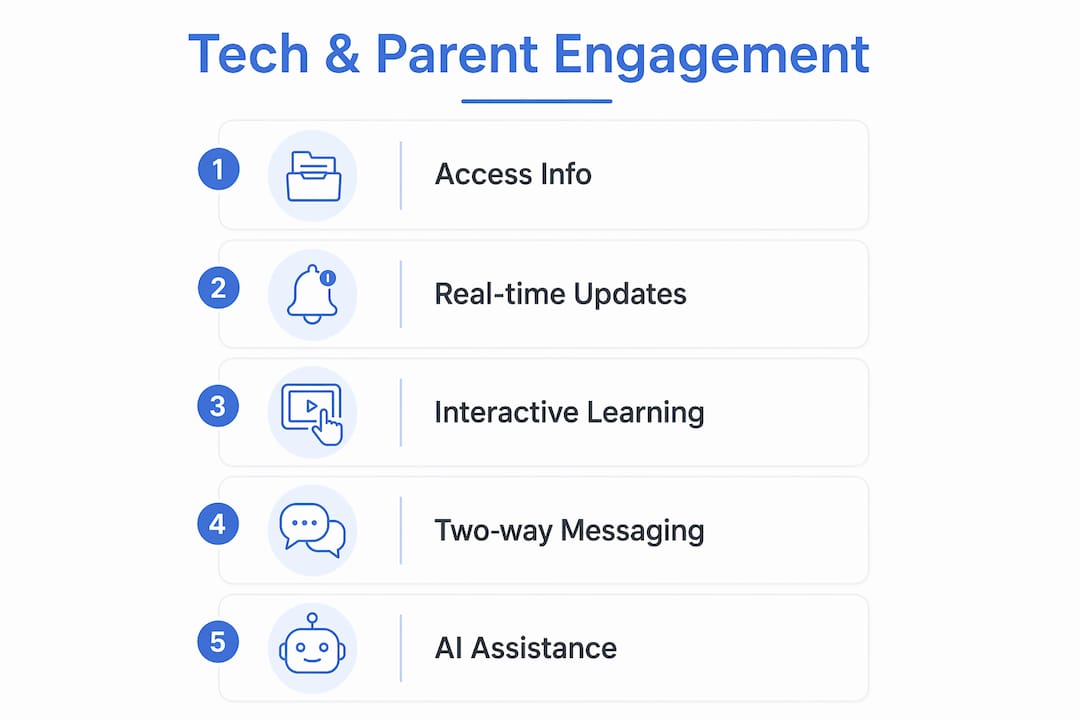
- Digital newsletters and school apps that deliver real-time updates on homework, events, and progress directly to a parent’s phone
- Parent evening booking systems that remove scheduling friction and increase attendance at formal review meetings
Pro Tip: If your child’s school uses a communication platform, activate push notifications. Parents who receive real-time alerts respond faster and stay more consistently engaged than those who check portals reactively.
Schools that invest in digital engagement for better outcomes consistently report stronger parental participation. The technology does not replace the relationship between teacher and parent. It makes that relationship easier to maintain.
What types of technology help parents engage directly with learning at home?
Digital tools for parental engagement extend well beyond school-to-home messaging. A growing range of apps, AI tools, and interactive programmes place parents at the centre of their child’s learning experience, not just as recipients of information but as active participants.
The most effective categories of technology currently available to parents are:
-
Mobile reading programmes. The Read to Kids pilot reached over 203,000 households by combining a digital library app with behaviour-change campaigns. Parents were encouraged to read aloud to children using curated content, building a home reading culture that persisted beyond the programme itself.
-
AI-assisted learning tools. In special education contexts, AI-enabled services are more effective when family learning support and home-school communication are high. AI does not replace parental involvement. It amplifies it.
-
ICT tools for children with additional needs. Apps, telehealth platforms, and specialist digital resources support parents of children with autism spectrum disorder, improving therapeutic and educational outcomes. Virtual reality, robotics, and chatbots are increasingly used in these contexts to help parents understand and reinforce learning strategies at home.
-
Learning dashboards. Parent-facing dashboards give families a window into their child’s progress. However, tailored visualisations are required for parents to make sense of educational data. Raw numbers without context rarely sustain engagement.
The table below compares the primary use cases for each technology type:
| Technology type | Primary benefit for parents | Best suited to |
|---|---|---|
| Mobile reading apps | Builds home literacy habits | Early years and primary age |
| AI learning tools | Personalises support and feedback | All ages, especially SEND |
| ICT and telehealth | Extends specialist support into the home | Children with additional needs |
| Learning dashboards | Tracks progress and flags concerns early | Primary and secondary |
Virtual involvement in parenting is not a compromise. Used well, it extends what parents can offer their children beyond the school gate and into everyday life at home.
How do you balance technology use with quality parent-child interaction?
The impact of technology on parents and children is not uniformly positive. How you use digital tools matters as much as which tools you choose. Research published in 2026 draws a clear distinction between two approaches: co-use and active mediation on one side, and restrictive mediation on the other.
Co-use and active mediation improve parent-child interaction quality. When a parent sits alongside a child using an educational app, discusses what appears on screen, and asks questions, the technology becomes a shared experience. Restrictive mediation, which focuses on limiting or controlling device use, reduces interaction quality. The device becomes a source of conflict rather than connection.
The challenge is that many parents are navigating this without guidance. Consider these realities:
- 81% of parents have used AI tools for parenting tasks, yet many report concerns about misinformation and the risk of replacing genuine human interaction
- Parental mediation strategies are part of a broader relational pattern, not isolated behaviour controls. The quality of the parent-child relationship shapes how technology use plays out
- Digital parental involvement programmes often suffer adherence decay over time, meaning parents start strong but gradually disengage without reminders, personalisation, or ongoing motivation
“Technology adoption alone is insufficient without active engagement. Parental involvement significantly moderates the perceived effectiveness of AI-assisted educational services.” — Research finding from Frontiers in Psychology, 2026
Digital literacy is the foundation here. Parents who understand how a tool works, what data it collects, and how to interpret its outputs are far better placed to use it purposefully. Schools have a responsibility to support this, and parents have a responsibility to seek it out. The goal is not to use more technology. It is to use it with intention.
How can parents practically integrate technology into their involvement?
Choosing the right tools and using them consistently is where many parents struggle. The following steps offer a practical framework for making technology work in your family’s context.
-
Start with your school’s existing platforms. Most UK schools now offer a parent app, a learning management system, or a communication portal. Before seeking external tools, explore what your child’s school already provides. Platforms like the eSchools mobile app are designed specifically to connect parents with school life in real time.
-
Choose tools matched to your child’s learning stage. A reading app suited to a Year 1 pupil differs significantly from a revision platform for a GCSE student. Align your choices with your child’s current needs rather than selecting the most feature-rich option available.
-
Use dashboards actively, not passively. Parent-facing dashboards require interpretation support to sustain engagement. When you log in, look for trends over time rather than single data points. Ask your child’s teacher to explain what the data means if it is unclear.
-
Combine digital tools with traditional involvement. The Read to Kids programme demonstrated that digital reading programmes are most effective when combined with behaviour-change campaigns and in-person support. Reading aloud, attending school events, and talking about learning at the dinner table remain irreplaceable. Technology supports these habits. It does not substitute for them.
-
Set a sustainable routine. Engagement tools work best when used regularly. Schedule a weekly check-in with your child’s school app, set reminders for parents’ evening bookings, and review progress reports on a fixed day each month.
Pro Tip: Ask your child’s school whether their communication platform supports two-way messaging. Platforms that allow you to reply directly to teachers, rather than just receive updates, produce significantly stronger engagement outcomes.
Online resources for parent participation are most effective when they fit naturally into your existing routine. The aim is consistency, not intensity.
Key takeaways
Technology-enabled parental involvement works when parents engage actively with digital tools rather than using them passively, and when schools design platforms that are accessible, personalised, and genuinely two-way.
| Point | Details |
|---|---|
| Communication platforms drive outcomes | TalkingPoints raised grades by up to 4.9 percentage points through accessible, multilingual messaging. |
| Co-use beats restriction | Sitting alongside children during digital learning improves interaction quality more than limiting device use. |
| AI amplifies, not replaces, involvement | AI tools in special education are more effective when parental engagement is high, not when it substitutes for it. |
| Dashboard design determines use | Parents need contextualised data, not raw figures, to sustain meaningful engagement with progress tools. |
| Blended approaches outperform digital-only | Combining apps with in-person habits and behaviour-change support produces the strongest long-term results. |
Technology and parental involvement: my honest perspective
Working in edtech for over a decade, I have watched the conversation around digital tools and parental involvement mature considerably. The early narrative was almost entirely optimistic. Give parents an app, and engagement will follow. The evidence now tells a more nuanced story, and I think it is a healthier one.
The most important shift I have observed is the move away from treating technology as a solution in itself. A school can deploy the most sophisticated learning platform available, but if parents do not understand what they are looking at, or if the tool sends generic updates that feel irrelevant, engagement drops within weeks. Adherence decay is real, and it is underestimated by most schools when they roll out new platforms.
What I find genuinely encouraging is the research on co-use. The idea that a parent sitting with a child and exploring an app together produces better relational outcomes than a parent simply monitoring screen time feels intuitively right. It reframes technology as a shared activity rather than a supervision challenge.
My concern about AI in this space is not that it will replace human connection. It is that parents will use it as a shortcut to involvement rather than a support for it. Asking an AI to summarise your child’s school report is useful. Delegating your understanding of your child’s progress entirely to an algorithm is not. The distinction matters, and I think schools need to be far more explicit about where that line sits.
The future of technology’s role in family communication is not more tools. It is better integration of fewer, well-designed tools into the genuine rhythms of family life.
— Ed
How eSchools supports parental engagement in UK schools
Eschools has spent over 14 years building digital tools that make it easier for UK schools to connect with parents in ways that actually work. From school websites that drive parent engagement to a dedicated learning platform that gives families real visibility into their child’s progress, every product is designed with usability and accessibility at its centre. The eSchools platform also includes a parents’ evening booking system that removes the administrative friction from one of the most important touchpoints in the school year. If you want to see how schools across the UK are using these tools to improve outcomes, explore our work and find out what is possible for your school community.
FAQ
What is the role of technology in parental involvement?
Technology-enabled parental involvement is the use of digital tools, platforms, and apps to help parents communicate with schools, monitor progress, and support learning at home. Research shows it improves attendance, grades, and family-school relationships when implemented with accessibility and usability in mind.
Which digital tools are most effective for parental engagement?
Multilingual communication platforms like TalkingPoints, mobile reading apps, and parent-facing learning dashboards have the strongest evidence base. Effectiveness depends on usability, language accessibility, and whether the tool supports two-way communication rather than one-way updates.
How does technology affect the quality of parent-child interaction?
Co-use and active mediation, where parents engage alongside children rather than simply monitoring or restricting device use, produce better parent-child interaction quality. Restrictive mediation reduces both device use and relational quality, according to 2026 research published in Frontiers in Psychology.
Can AI tools genuinely help parents support their children’s education?
AI tools are most effective when parental involvement is already high. Research on AI-enabled special education services confirms that parental engagement significantly moderates how effective these tools are perceived to be. AI supports involvement. It does not replace it.
How do I stay consistently engaged with my child’s school through technology?
Set a fixed weekly routine for checking your school’s communication platform, activate push notifications, and use two-way messaging features when available. Digital engagement programmes often suffer adherence decay over time, so building technology use into an existing habit is more sustainable than relying on motivation alone.